
The Chinese Scholar's Study.
This is not interior design. It is the reconstruction of a cultural world — composed, never assembled, and intended to be lived within.
Two traditions at the core.
Two historical lineages anchor this practice. They are not styles to be quoted, but systems to be understood — and, where appropriate, continued.
Neiting Gongzao.
imperial court ateliers & presentation spaces.
The imperial workshop tradition — where scholarly objects, ritual implements, and presentation interiors were conceived as a single coherent practice, with the rigour of a court behind every choice.
Sanxitang.
Qianlong's celebrated study.
Eight square metres that nonetheless contained an entire intellectual world — proof that a Scholar's Study is not a question of scale, but of composition, restraint, and the disciplined choice of every object within it.
These spaces were not designed as displays. They were designed to organise thought, perception, and conduct.
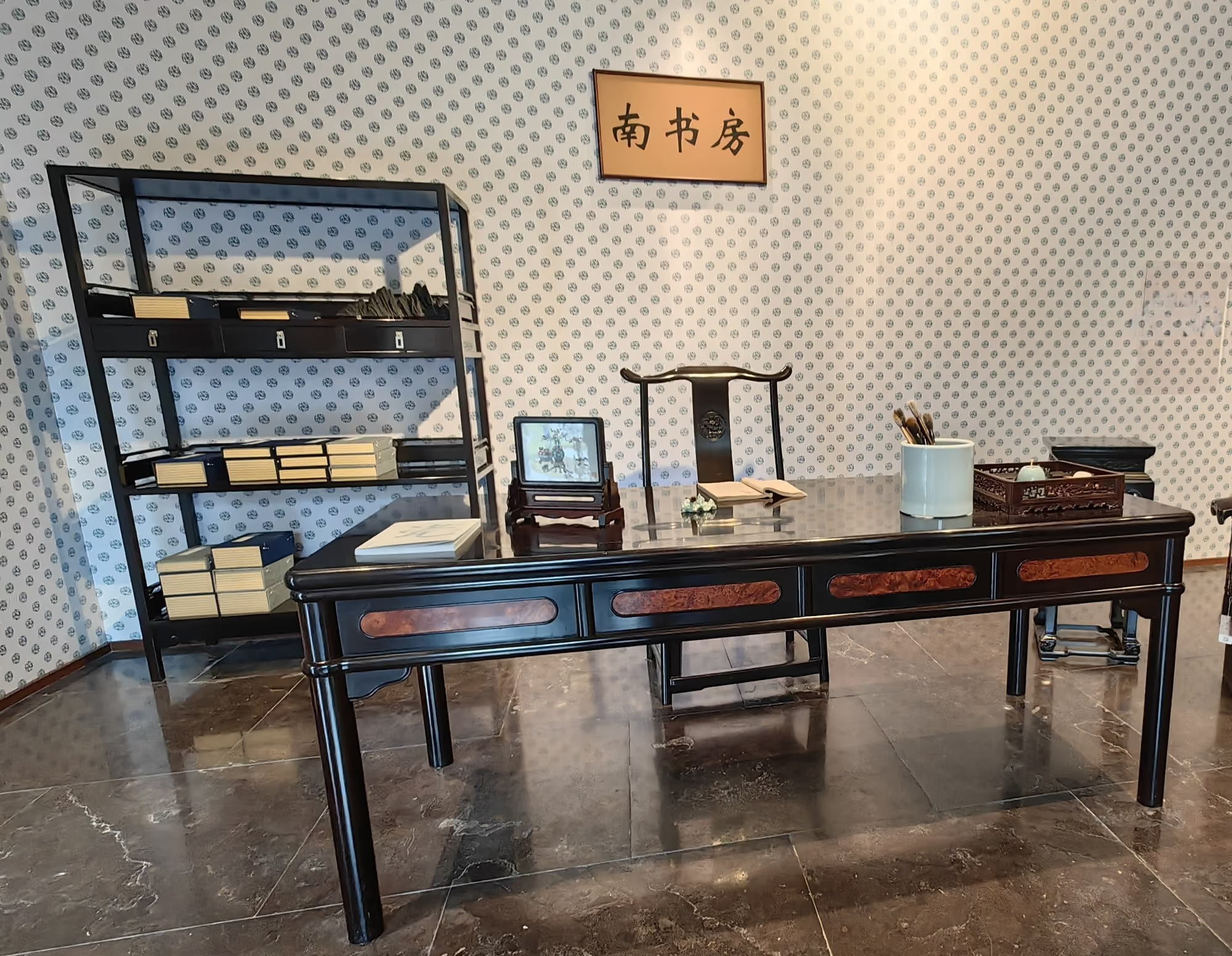
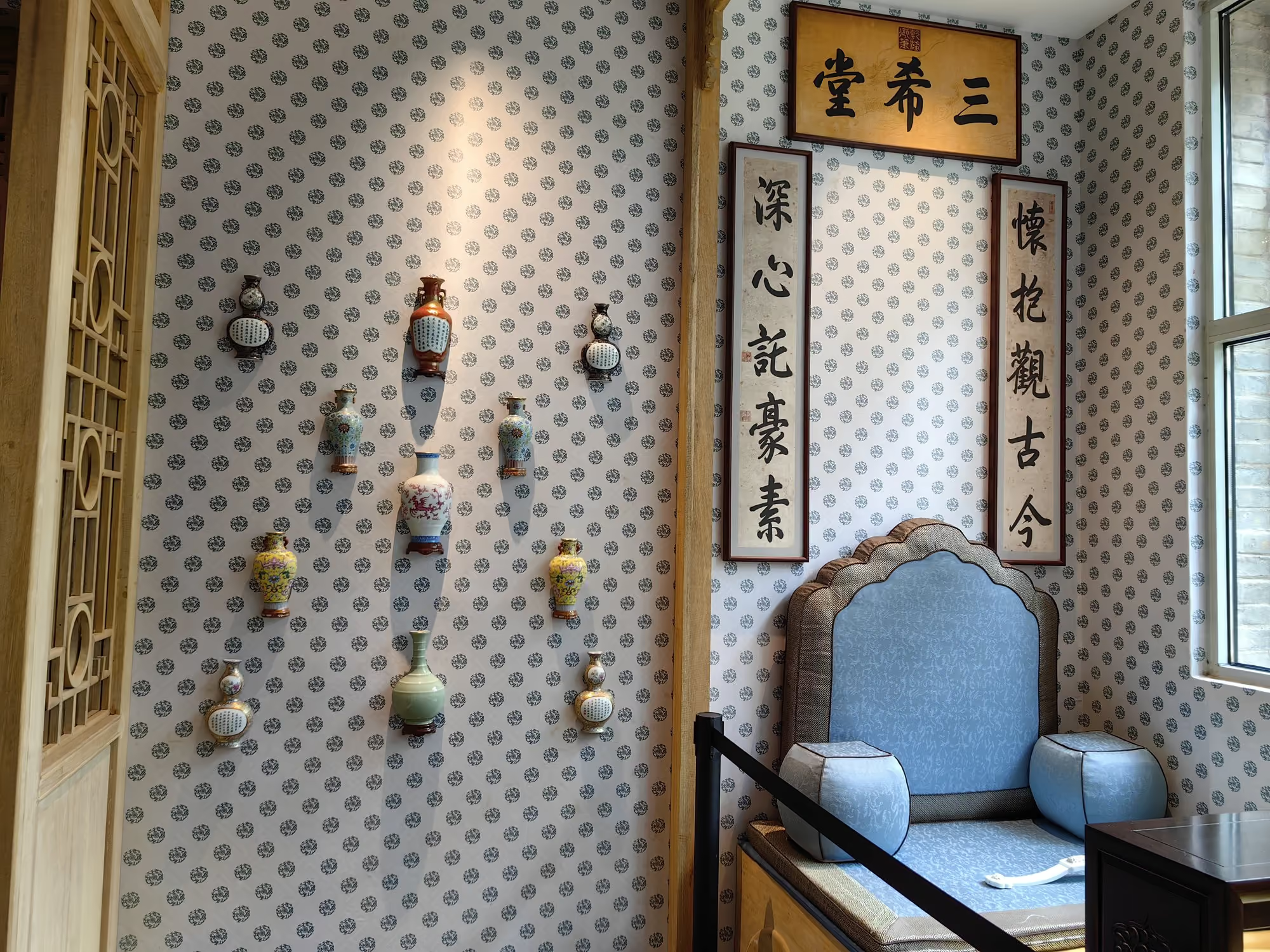
A complete spatial system.
Each Study is conceived as a complete cultural environment. It is not modular. It is not repeatable. It is created to be lived within — and to endure.
Spatial layout.
Architectural proportion.
Room composition, sightlines, the relationship between vertical and horizontal — calibrated to the scholarly purpose of the room.
Furniture.
Built-in elements.
Tables, cabinets, screens, and architectural insertions — produced in collaboration with select local workshops, in direct response to the room.
Objects.
Porcelain, calligraphy, painting.
The selection and placement of porcelain, scholar's objects, calligraphy, and paintings — chosen as part of the spatial argument, not as decoration.
Cultural logic.
The meaning of the room.
The restoration of the cultural logic that gives the space meaning — the reason this room is composed this way, and not another.
It is not repeatable.
It is not trend-driven.
It is composed — to be lived within.
Composed, not assembled.
Each Scholar's Study is approached not only as a conceptual reconstruction, but as a process of precise realisation — developed in direct response to the room's specific spatial conditions. We work in collaboration with select local workshops and craftsmen capable of producing refined Chinese-style furniture and architectural elements. These partnerships allow each project to be developed in dialogue with the room, rather than through standardised production.
Every commission is shaped through careful study of the client's interior environment, functional needs, and cultural orientation. From proportion and material to object placement and circulation, each decision is made to ensure coherence between space, objects, and lived experience.
In this way, the Scholar's Study is not assembled. It is composed — as a complete and inhabitable cultural structure.
Where the practices converge.
The Chinese Scholar's Study is not separate from Wismoria's other practices. It is where they converge — as a lived cultural environment.
The Collection.
Historical standards.
The Collection provides the historical anchors and material standards against which every choice within the room is measured.
Global Classroom.
Cultural immersion.
Global Classroom provides the field of cultural immersion — the lived understanding of the traditions a Study is intended to honour.
Commissions.
Singular porcelain.
Private Commissions provide the singular porcelain works — composed into the room as part of the same continuous cultural argument.
For whom.
Collectors & patrons.
Building lived cultural environments.
Collectors and cultural patrons who wish to inhabit, not only acquire — to live with the culture they study, rather than display it at arm's length.
Scholars & stewards.
Composing a room that thinks.
Scholars and cultural stewards who require a room shaped by the discipline of the work they pursue — a Study, in the strict sense of the word.
Institutions.
Serious private individuals.
Institutions and serious private individuals for whom such a space is part of a long cultural commitment — academic, charitable, or familial.
For those who seek not only to own culture, but to live within it.
Begin a
Conversation.
Every meaningful cultural engagement begins with a conversation.